What is Periodic Times Table?
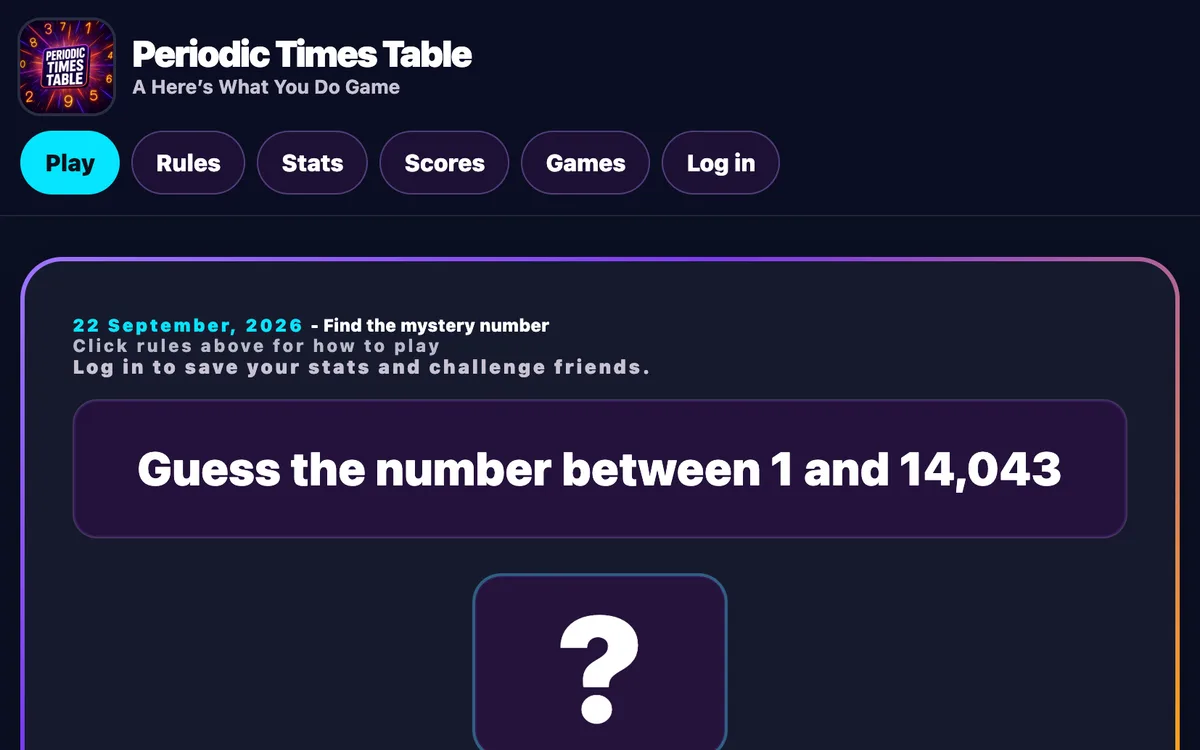
Guess a dated number from 1 to 14,043; distance comes back as atomic-number math. Find a shared mystery number between 1 and 14,043. After a guess, your distance is shown as a math expression made of periodic-table elements, each standing for its atomic number. A distance within 118 can be one element. Other distances use a product of two atomic numbers, and sometimes a third element added or subtracted with multiplication first. Login is optional and only if you want stats saved. It belongs to the wider family of DLE games: compact browser puzzles that give players a repeatable challenge and a reason to return the next day.
How to play Periodic Times Table
- Guess a number between 1 and 14,043.
- Read the distance as periodic-table elements, each worth its atomic number.
- A distance within 118 can be one element. Other distances use a product of two atomic numbers, and sometimes a third element added or subtracted, with multiplication first. Three elements does not mean you are farther away than a two-element guess.
Why it is worth trying
Periodic Times Table works well as a daily habit because a round usually takes 5-10 min. The rules are understandable in one session, but better pattern recognition can still improve future attempts.
Players who enjoy math, science, daily will find the closest fit here. The shared daily format also makes it easy to compare results with friends without requiring a long multiplayer session.
Periodic Times Table FAQ
Is Periodic Times Table a daily game?
Yes. The play page labels today’s date and asks you to find that day’s mystery number.
Do I need an account?
No. You can play without signing in. Login is optional if you want stats saved.
Does a longer element expression mean I am farther away?
No. Three elements in the expression does not mean you are farther than a guess shown with two.