Colour Match, Second Sight, and All/Some are listed in the DLE Directory. This comparison explains their daily loops, the skills each game emphasizes, and which one makes the best starting point for different players.
Colour Match makes RGB estimation visible and measurable
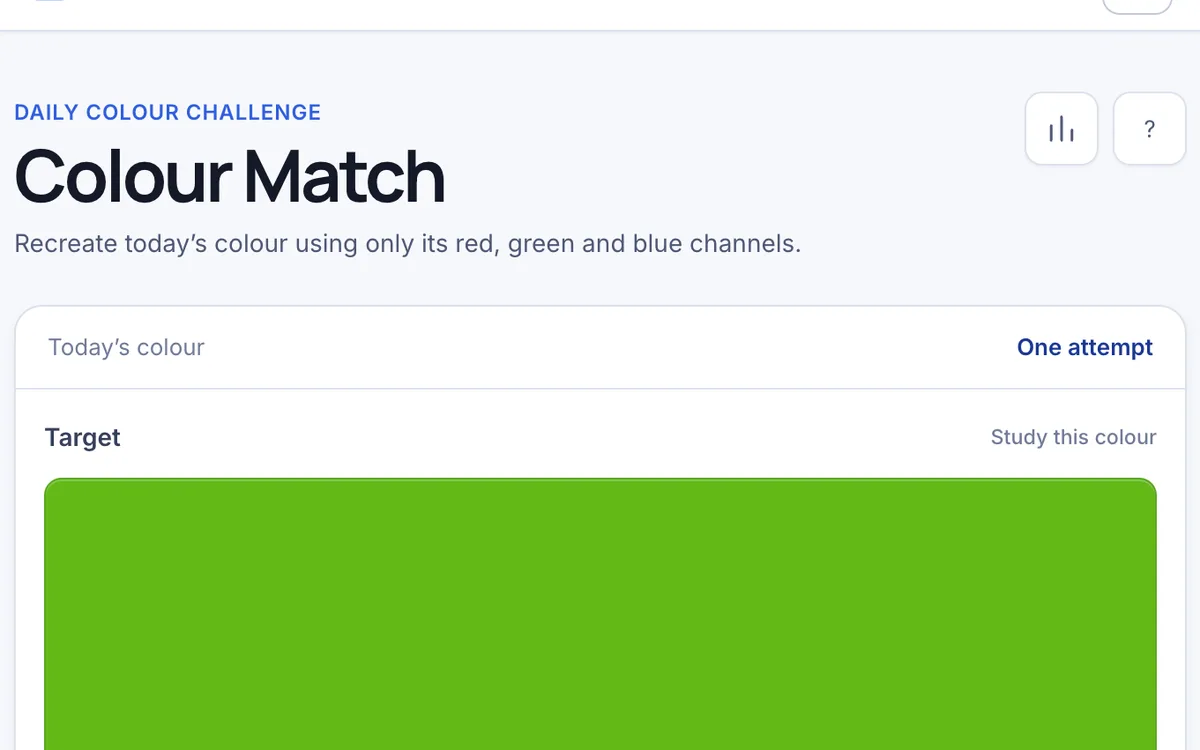
Colour Match keeps the target colour on screen while you rebuild it with red, green, and blue controls. Each channel runs from 0 to 255, and you receive one submission for the daily target.
After the guess is locked in, the game compares each submitted channel with the answer. The score is the total RGB difference, so lower is better and zero is a perfect match. The numerical result makes it possible to see whether the mistake came from red, green, blue, or a combination of all three.
This is the most direct game in the set because the reference never disappears. It suits players who enjoy fine visual adjustment and want immediate feedback on how their perception maps to actual RGB values.
Second Sight tests colour memory instead of matching
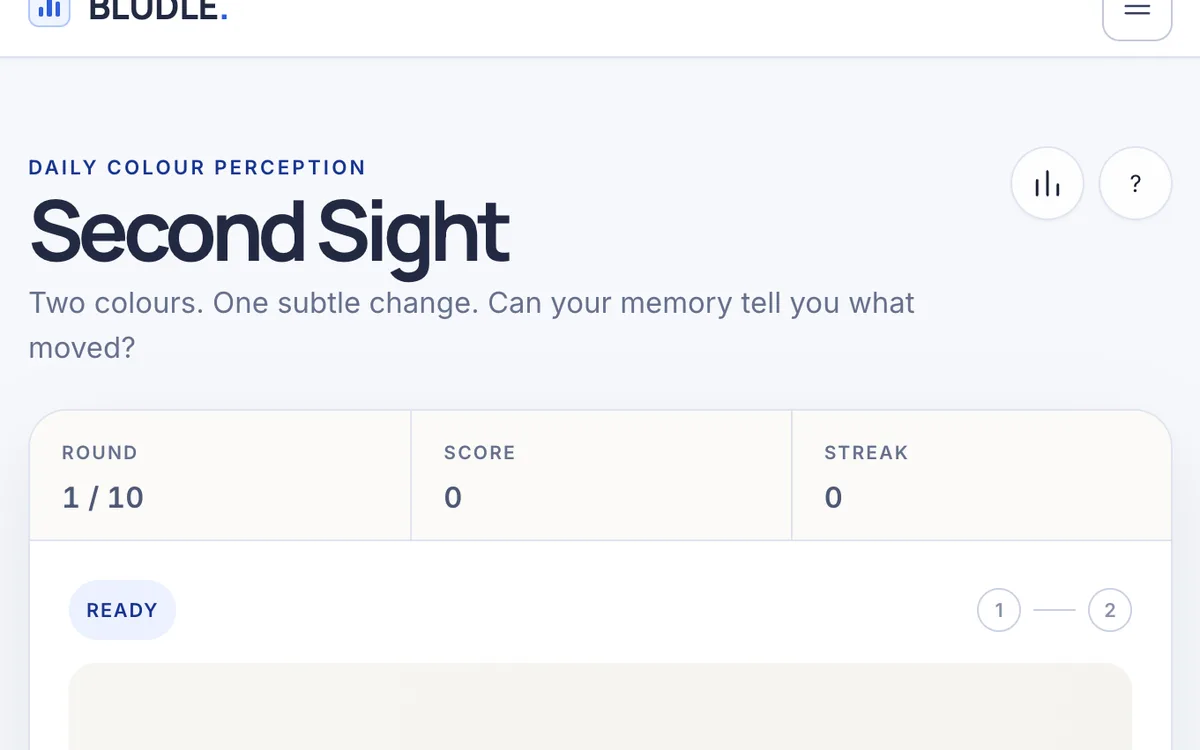
Second Sight removes the side-by-side reference. Across ten daily rounds, it shows one colour, inserts a pause, and then shows another. Your task is to identify the single change: lighter, darker, more vivid, more muted, or a shift in hue.
The two colours appear together only after the answer, along with an explanation of the dimension that changed. As the daily challenge progresses, viewing time becomes shorter and the gap becomes longer, so later rounds place more pressure on memory than the opening comparisons.
Second Sight is better suited to players who want a sequence of quick perceptual decisions rather than one carefully adjusted mix. It also provides more room for recovery than Colour Match: one uncertain comparison does not consume the entire daily session.
All/Some turns category relationships into a diagram
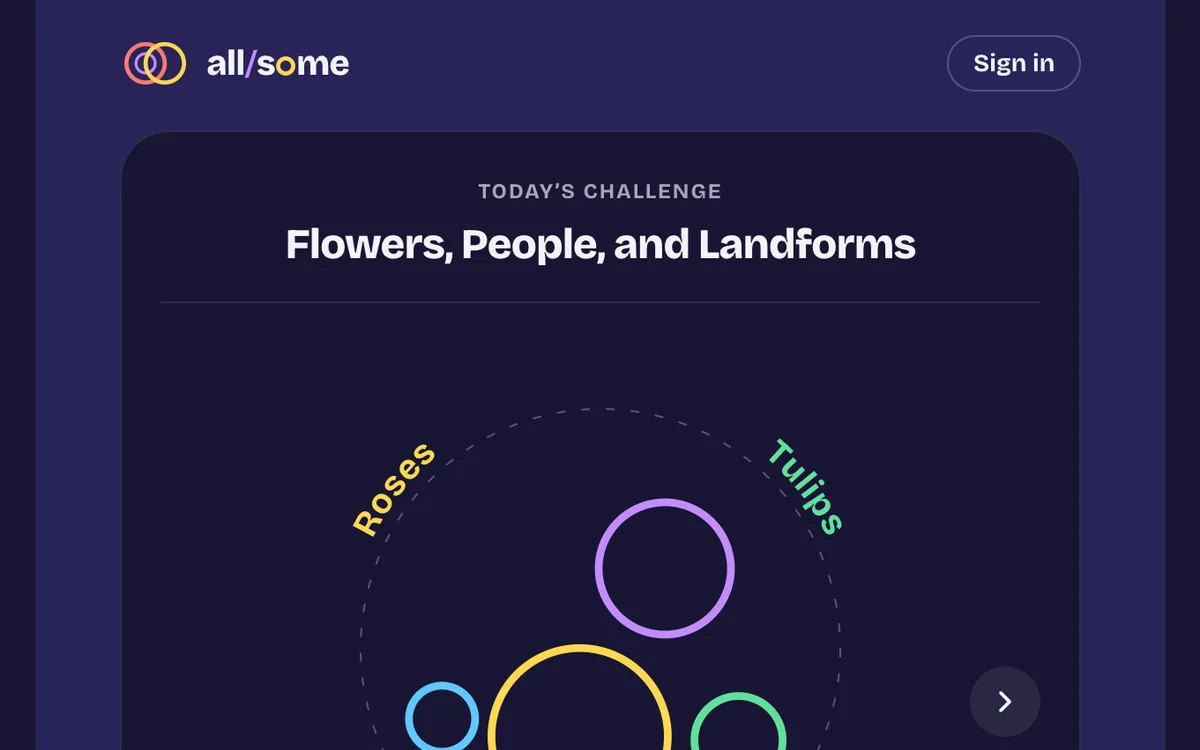
All/Some moves away from colour and into set logic. Words sit around a diagram of overlapping circles, and the puzzle asks you to determine which categories apply to all, some, or none of the available items.
The daily challenge is distinct from the site’s additional themed collections. An account is optional for core play, while signing in can be used to retain streak progress. The central challenge remains the same either way: understand how several category statements interact before placing the words.
This is the most language-dependent choice of the three. It rewards careful reading and set relationships rather than colour sensitivity, making it a useful alternative when visual estimation is not the kind of challenge you want.
Which daily game should you try first?
The best choice depends on whether you want estimation, memory, or deduction:
- Choose Colour Match for one focused RGB estimate with numerical feedback.
- Choose Second Sight for ten short rounds that test colour memory.
- Choose All/Some for category logic built around words and overlapping sets.
Colour Match has the shortest and most final daily loop because there is only one submission. Second Sight spreads the challenge across ten rounds, while All/Some asks for a slower reading of several relationships. None is universally harder; each places the pressure in a different part of the solve.
FAQ
Are Colour Match, Second Sight, and All/Some daily games?
Yes. Colour Match provides one daily target, Second Sight provides ten daily comparisons, and All/Some offers a shared daily diagram challenge alongside additional collections.
What is a perfect Colour Match score?
A score of zero is perfect. The score adds the distance between your submitted red, green, and blue values and the target values, so lower scores indicate a closer match.
Is Second Sight a medical vision test?
No. It is a perceptual memory game rather than a diagnostic assessment. Screen settings and ambient lighting can affect how its colours appear.
How is All/Some different from the two colour games?
All/Some uses words, categories, and overlapping circles. It tests set-based deduction rather than RGB estimation or colour memory.
Conclusion
Colour Match, Second Sight, and All/Some share a daily schedule but test different skills. Colour Match measures one visible RGB estimate, Second Sight asks you to remember a changing colour, and All/Some turns category statements into a diagram. Choose the kind of relationship you want to reason about, then return when the next daily challenge arrives.