CineLinkr, PixelLinkr, and Little Worlds are available in the DLE Directory. Here is how their daily modes work, where the difficulty comes from, and which one is likely to suit you best.
CineLinkr turns movie knowledge into a grouping puzzle
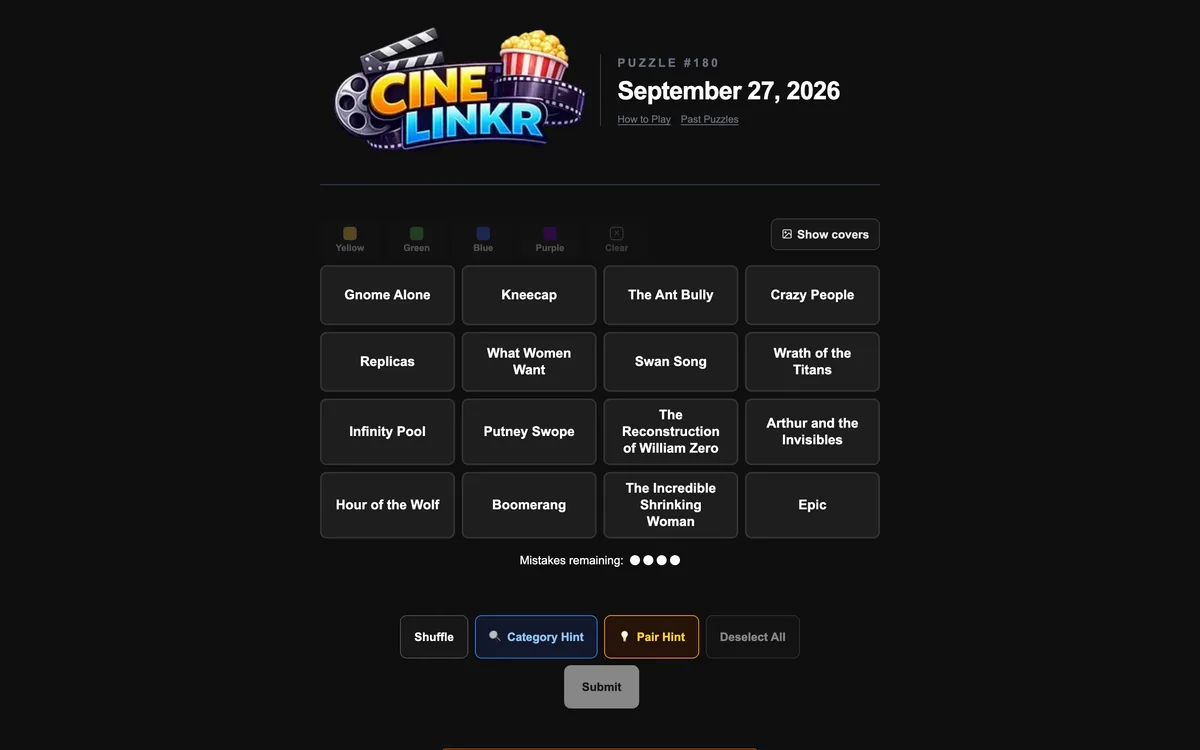
CineLinkr places sixteen films on one board and hides four groups of four among them. Selecting a plausible set is only the start: the titles must share the connection intended by the puzzle, and overlapping possibilities can make an early guess look more certain than it is.
You have four mistakes for the full board. Category and pair hints are available when recognition alone is not enough, while the archive provides earlier boards after the current puzzle is complete. A new puzzle arrives at midnight.
The format works best for players with broad movie knowledge rather than expertise in one narrow genre. Recognizing a title helps, but solving the board also depends on noticing relationships across casts, themes, franchises, wording, or other shared traits.
PixelLinkr uses the same structure for video games
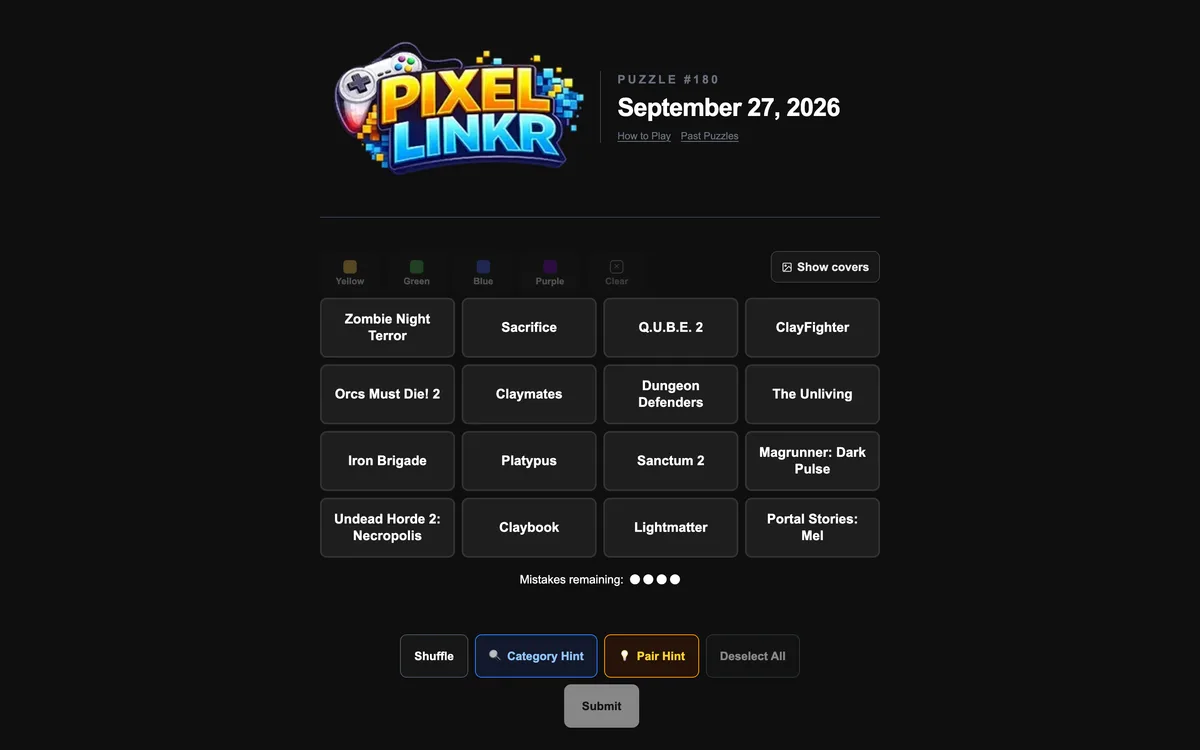
PixelLinkr uses the same sixteen-item, four-group structure, including the four-mistake limit, optional hints, and archive. The important difference is the subject: every tile is a video game rather than a film.
That change matters because grouping puzzles depend heavily on what the player already recognizes. Someone who follows games may spot a connection between titles, studios, mechanics, characters, or series more quickly than a movie-focused player would. The familiar rules make it easy to switch between CineLinkr and PixelLinkr without learning a second interface.
PixelLinkr is the better starting point when game history and releases are already part of your everyday knowledge. If many titles are unfamiliar, however, the board can become a trivia test before the grouping logic has a chance to begin.
Little Worlds replaces trivia with relational logic
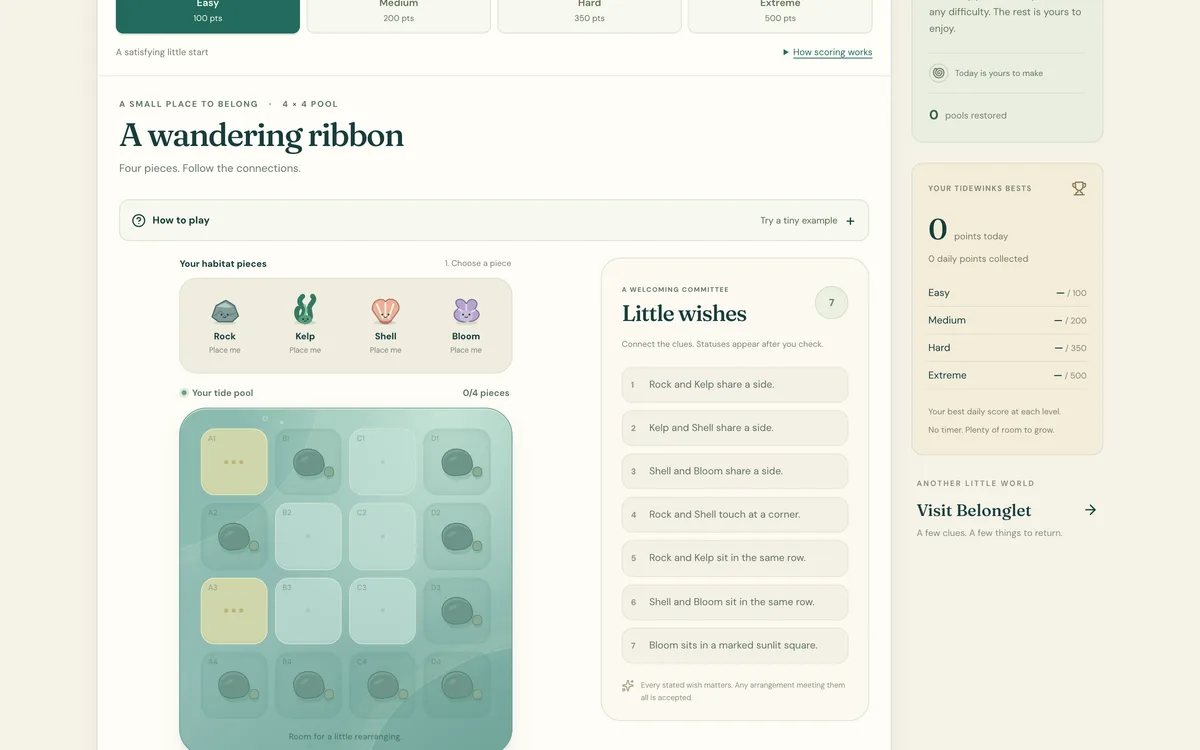
Little Worlds takes a different route. It contains two small logic settings: Tidewinks asks you to arrange pieces in a tide pool so that every listed wish is satisfied, while Belonglet asks you to return found objects to the correct neighbors.
Both worlds have Daily and Practice play. Completing one daily puzzle in either world, at any available difficulty, is enough to maintain the game’s streak. This gives players some control over the type of reasoning they want without removing the shared daily structure.
Unlike CineLinkr and PixelLinkr, Little Worlds does not depend on recognizing entertainment titles. The challenge comes from reading several conditions together and finding an arrangement that satisfies all of them. It is a stronger fit for players who prefer deduction and placement over knowledge-based connections.
Which daily game should you try first?
Choose according to the knowledge or reasoning style you want to use:
- Choose CineLinkr if films are your strongest reference point.
- Choose PixelLinkr if video games are more familiar.
- Choose Little Worlds if you prefer logic that does not rely on entertainment trivia.
CineLinkr and PixelLinkr have the clearest pressure because four wrong groups end the attempt. Little Worlds is less about protecting a mistake allowance and more about reconciling several clues. That makes the first two feel like compact trivia challenges, while Little Worlds is better suited to methodical deduction.
FAQ
Are CineLinkr, PixelLinkr, and Little Worlds updated daily?
Yes. CineLinkr and PixelLinkr publish a new shared grouping board at midnight. Little Worlds provides dated Daily puzzles alongside separate Practice play.
Do CineLinkr and PixelLinkr have the same rules?
Their main rules match: sixteen titles, four hidden groups of four, and four allowed mistakes. CineLinkr uses films, while PixelLinkr uses video games.
Can you play earlier CineLinkr and PixelLinkr puzzles?
Yes. Both games include an archive of past boards. The archive is separate from the current daily puzzle.
Which Little Worlds mode counts toward the daily streak?
One Daily solve in either Tidewinks or Belonglet counts, and the game allows the player to choose an available difficulty. Practice puzzles are separate.
Conclusion
These three daily games divide neatly by interest. CineLinkr rewards movie knowledge, PixelLinkr shifts the same grouping challenge to video games, and Little Worlds trades title recognition for relational logic. Start with the subject or reasoning style that feels most natural, then use the shared daily format as a reason to return for a fresh board.